Sign In Join Early Access
For Azure DevOps & Jira Teams

Stop Manually Breaking Down Epics. Let AI Handle It.

AJAIA turns high-level epics into a sprint-ready backlog of user stories, tasks, and test cases in less than a minute for Azure DevOps and Jira.

AJAIA gives ADO & Jira teams back 400+ hours/year with AI-powered epic breakdown, real-time platform sync, and portfolio dashboards that eliminate status meetings.

In early access - shape the product with us · No credit card · Setup in 5 minutes

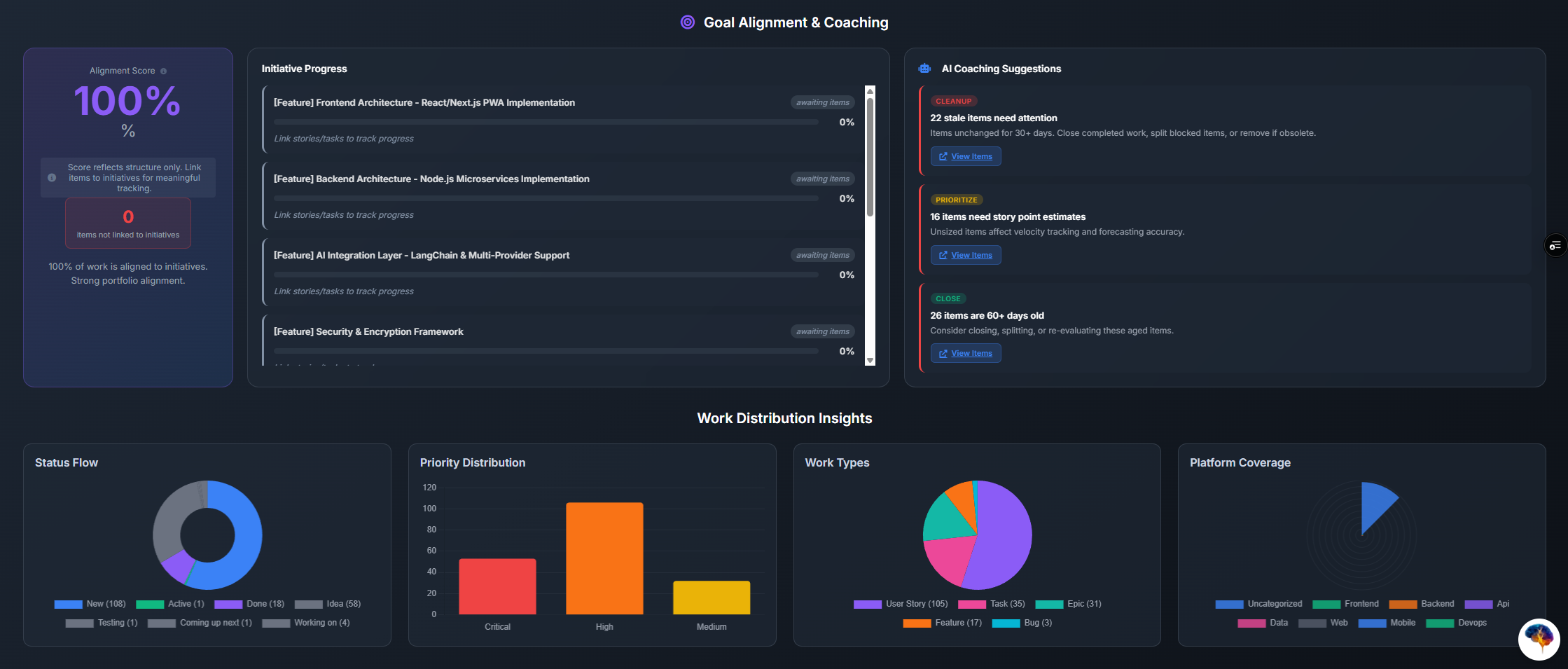
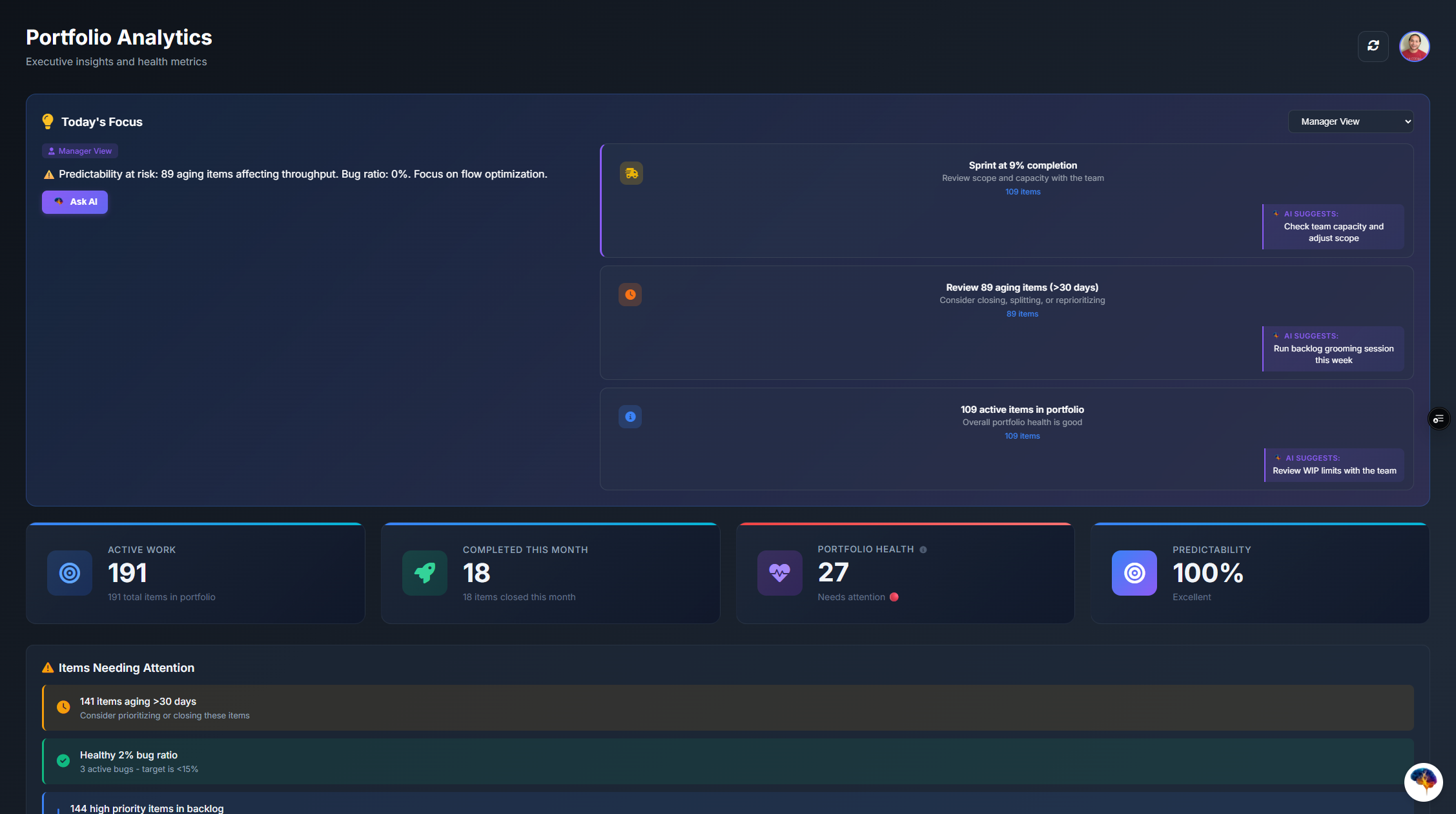
AJAIA Dashboard showing epic breakdown
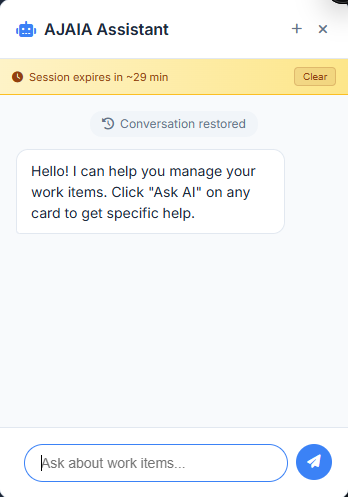
AJAIA AI Assistant breaking down an epic
AI Assistant
What's New?

Built for Teams Living in Both ADO + Jira

Most AI tools help inside one platform. AJAIA connects your whole portfolio.

Jira / ADO Native AI
Marketplace Plugins
AJAIA
ADO ↔ Jira 2-Way Sync 2-Way Sync
Portfolio Health Dashboard Health Dashboard
Desktop + ADO Extension + MCP Multi-Platform
Epic → Story + Task Breakdown Epic Breakdown
Gherkin AC + Test Cases Test Cases
PM/EM Visibility Focus PM Visibility

Native AI is Great—But Single-Tool

Jira and ADO AI help with local, one-off suggestions. But they don't give PMs a unified view across both platforms or opinionated health metrics.

Plugins Treat Platforms as Silos

Refina, StoriesOnBoard, and marketplace plugins support one ecosystem at a time—or sync to a separate hub, not to each other.

AJAIA Connects Your Whole Portfolio

Cross-tool sync, opinionated delivery health, and multi-surface access (web, desktop, extension, MCP) for teams straddling ADO + Jira.

The Math

Here's How We Got to 400 Hours/Year

Conservative estimates based on typical PM/EM workloads

5 hrs/week on manual breakdown & sync = 260 hours/year
2 hrs/week in status meetings = 104 hours/year
3 days/month in rework due to bad specs = 36+ hours/year
That's ~400 hours/year your team is NOT shipping.
Why Now
  • Senior management is pushing teams to adopt AI. You've been told to "figure out how to use AI" but most tools don't integrate with ADO or Jira.
  • Velocity expectations are at an all-time high. Teams are distributed, sprint cycles are shorter, and leadership expects real-time visibility—not weekly status reports.
  • AI can now understand context. Your backlog, your team's patterns, your definition of done. The hours spent on manual coordination don't have to be the cost of doing business.

Right now, Azure DevOps and Jira teams are overwhelmed.

Work moves fast. Too fast.

  • Your backlog is overloaded. Epics are vague. User stories lack detail.
  • Nobody agrees on acceptance criteria. Test cases don't exist until QA pushes back.
  • Your PM is managing spreadsheets. Your manager needs visibility into multiple teams at once.
  • Your delivery lead is glued to status meetings.

AI is finally smart enough to solve this. AJAIA was built specifically for this moment—and it's the AI solution leadership is asking for.

The Problem

Sound Familiar?

These problems are costing your team hundreds of hours every year

Epic Breakdown Takes Hours

You spend more time breaking down work than shipping it. Acceptance criteria gets rushed. Dev and QA end up with different interpretations. Mid-sprint re-scoping becomes the norm.

Result: 3+ days wasted per epic

Your PM Works Weekends

ADO and Jira are out of sync. Changes happen in one place, not the other. The single source of truth? Doesn't exist.

Result: Burnout. Mistakes. Missed dependencies.

Status Meetings Don't Scale

Nobody has real-time project health. So you schedule meetings to find out if you're on track. Then meetings about those meetings.

Result: 2+ hours/week of meeting tax

Test Coverage is a Wish

Test cases are written after dev. Nobody has Gherkin acceptance criteria. QA doesn't know what "done" looks like until they see it.

Result: Rework. Delays. Production surprises.
The Vision

What If Your Backlog Just Worked?

What if every story had clear acceptance criteria in Gherkin format - ready for automation?

What if ADO and Jira synced automatically without your PM becoming the bridge?

Your manager opens a dashboard and knows exactly what's at risk. No status meeting required.

Your team spends 400 fewer hours/year on coordination and ships 40% more features.

This is already happening for teams using AJAIA.

How It Works

From Epic to Done in 4 Steps

AJAIA is built specifically for Azure DevOps and Jira teams

1

Write Your Epic

Any level of detail. High-level is fine. AJAIA ingests it, understands your board context, your team's patterns, your past epics, your velocity. It's not generic AI—it knows your workflow.

2

One Click: Breakdown

Features, Stories, Tasks, Test Cases. Gherkin acceptance criteria. Sized for your team. Pushed directly to your ADO/Jira. No manual editing. No friction.

3

Real-Time Sync

Changes in ADO flow to Jira automatically. Changes in Jira flow back. Your PM stops being a human data pipeline.

4

Live Visibility

Portfolio dashboard for managers. Health scores. Risk detection. Goal alignment. Real-time data. No more status meetings.

Works Where You Are—With Your Context

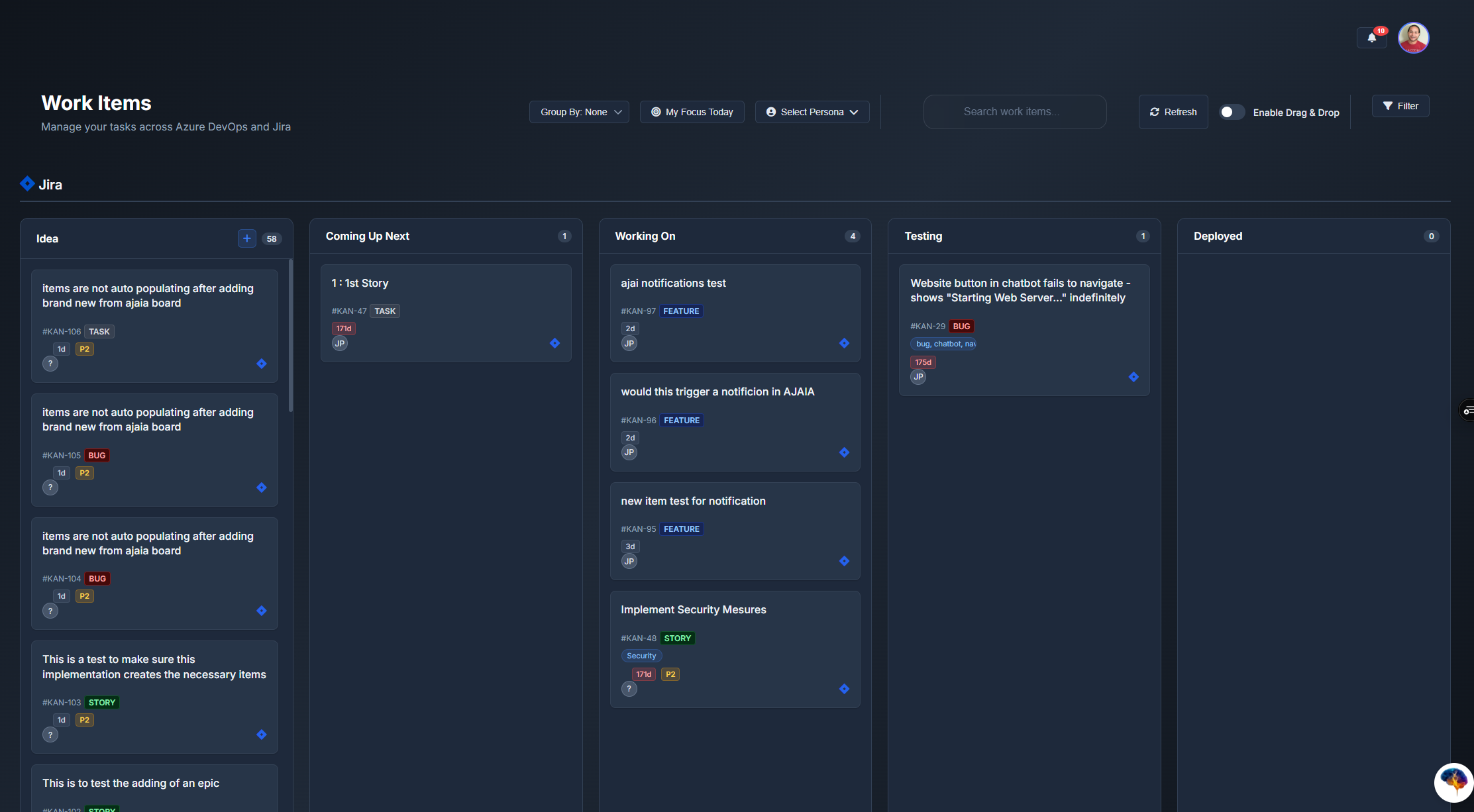
Start a conversation on desktop. Continue it on web. Your AI remembers everything.

Web Dashboard Full portfolio analytics
Desktop (Windows) Always-on widget
Mobile Web iOS & Android browsers
ADO Extension Break down in ADO
MCP Integration Claude/Cursor access

Single sign-on. Synced conversations. Shared AI context.

All your work syncs automatically via PostgreSQL cloud backup—no manual data transfer needed.

See It In Action

The Complete Product Journey

From login to live dashboards—explore every feature

What You Get

Built for Real-World Impact

Projected savings based on typical PM/EM/QE workflows I analyzed across my own team

80% Faster Epic Breakdown

What takes 3 hours manually now takes 15 minutes. AI generates user stories, tasks, acceptance criteria, and test cases - reviewed by you, then pushed to your backlog.

15 min instead of 3 hours

Gherkin Test Cases Included

Every story comes with structured acceptance criteria in Gherkin format. QA knows exactly what "done" looks like before dev starts.

4 hrs saved per sprint

Real-Time Visibility

Portfolio dashboards show project health across all teams. No more asking "are we on track?" in every standup.

Zero status meetings needed
Claude AI-Powered Analysis
Real-Time ADO ↔ Jira Sync
Desktop + Web + Extension
Enterprise Security

You're Safe With Us

AES-256 Encryption
SOC 2-Aligned Controls
400+ Security Tests
Encrypted Storage

We never read source code. With permission, we access work items and commit messages. API keys encrypted at rest.

Pricing

Pricing That Scales With You

Start free. Upgrade when you're ready.

Early Access Pricing

Introductory pricing for early adopters. Rates may be adjusted based on usage metrics and operational costs as we learn what it takes to run the platform at scale.

Starter

Best for individual contributors

Solo PMs or developers managing their own backlog

$69 /month
  • 1 user
  • 150 AI analyses/month
  • Epic breakdown
  • ADO + Jira integration
  • Email support
Join Early Access

Team

Best for 3-5 squad teams with shared PM/EM

Small product teams needing collaboration and real-time sync

$199 /mo + $49/seat
  • 3 seats included
  • 1,500 AI analyses/month
  • Desktop App for all
  • Real-time sync (5 min)
  • Admin controls
Join Early Access

Business

Best for growing orgs with multiple portfolio managers

Mid-size companies managing 6-15 teams with SSO requirements

$449 /mo + $39/seat
  • 10 seats included
  • 6,000 AI analyses/month
  • SSO / SAML
  • Audit logs
  • Account manager
Join Early Access

Enterprise

Best for large organizations with enterprise needs

15+ teams requiring custom SLAs and on-premise deployment

Custom
  • Unlimited users
  • Unlimited AI
  • Custom SLA
  • On-premise option
  • 24/7 support
Contact Sales

Stop the Busywork. Start Shipping More.

Join teams reclaiming 400+ hours/year from manual epic breakdown, sync headaches, and status meeting tax.

Full feature access
No credit card required
Cancel anytime
What if it doesn't work for me?

Try AJAIA on one epic. If it doesn't save you time in 7 days, you lose nothing—keep the work item structure we generated and walk away. No charge, no hassle.

Built by Jefrie, a QE Who Felt the Pain

Why I Built AJAIA

I'm a QE on a 15-person team managing 3 different apps across Azure DevOps and Jira. We have daily standups and bi-daily refinement sessions, which takes up a significant amount of our time.

What concerns me most is seeing the same challenges repeat every sprint—not because anyone isn't trying, but because the process itself creates friction.

Epic breakdowns often happen under time pressure before sprint planning. Acceptance criteria can be high-level: "The user can do X." But the details—edge cases, validation rules, error handling—get worked out later, which leads to rework.

Development and QA sometimes work from different interpretations of requirements. This isn't anyone's fault—it's just that when acceptance criteria isn't fully detailed upfront, everyone fills in the gaps differently.

Late-stage discoveries happen. A few days before release, we might find an edge case that wasn't documented—like handling account switching mid-flow—and it becomes a blocker because nobody explicitly wrote it down.

I realized: the challenge isn't lack of effort—it's that breaking down Epics thoroughly takes hours that teams often don't have in the moment.

So I built AJAIA to do the part that takes the most time: turning a high-level Epic into detailed stories with Gherkin acceptance criteria, edge cases, and test scenarios—ready for dev and QA to align on before a single line of code is written.

What Changed After I Started Using AJAIA:

Here's what changed on my own 15-person, 3-app team:

  • Epic breakdowns that used to take 3+ hours now take 15 minutes
  • QA gets structured test cases before dev starts, not after
  • Fewer "wait, what's the edge case?" arguments in the middle of the sprint
  • Our PM stopped working weekends to keep ADO and Jira in sync

AJAIA isn't perfect yet—it's in early access because I want to make sure it solves the real problems teams face, not just the ones I think exist.

If you're tired of fixing the same preventable issues sprint after sprint, you'll be among the first teams to shape where this product goes.